Empire Metals Limited Announces Pitfield Product Development and Marketing Update
Empire Metals Limited / LON:EEE, OTCQX:EPMLF / Sector: Natural Resources LONDON, UK / ACCESS Newswire / September 24,
Press Release Disclaimer: This is a press release distributed through the XPR Media network. It has not been independently verified by our newsroom.


Empire Metals Limited / LON:EEE, OTCQX:EPMLF / Sector: Natural Resources
LONDON, UK / ACCESS Newswire / September 24, 2026 / Empire Metals Limited, the AIM-quoted and OTCQX-traded exploration and development company, is pleased to announce the results from its recent titanium dioxide (“TiO2“) product development work. The programme has delivered an uncoated rutile pigment from mineral concentrates produced from the in-situ, high-grade weathered ore that extends across the Pitfield Titanium Project in Western Australia (“Pitfield” or the “Project”).
Highlights
- Rutile pigment successfully produced from Pitfield’s anatase-rich in-situ weathered ores, indicating that the crystal form of the final pigment product is determined by processing conditions rather than by the titanium minerals present in the ore.
- Pitfield’s ores are naturally low in deleterious elements, in particular the radionuclides, so the raw pigment produced in the refining stage is well suited to the premium pigment market and as feedstock for titanium sponge metal production.
- Empire is now targeting a refined and coated rutile pigment, for the architectural coatings market, where current global weighted average prices are approximately US$3,250/tonne (Source: TiPMC Consulting 2026).
- Architectural coatings are the largest single market sector for TiO2 pigment, consuming 2.3Mt annually, approximately 33% of global pigment production (Source: TiPMC Consulting 2026).
- Independent benchmarking puts the costs of the final finishing stage, that is the conversion of raw pigment into coated rutile pigment, at approximately US$250 to US$320 per tonne for the sulphate pigment industry. This excludes all upstream mining and processing costs (Source: TiPMC Consulting 2026).
Shaun Bunn, Managing Director, said: “The ability to use conventional process technologies to convert the titanium-rich minerals found within the in-situ weathered cap at Pitfield directly into high-value, rutile crystal pigments is an important technical milestone for the Company, and one that clearly sets Pitfield apart from the rest of the titanium industry.
“Taking advantage of the low levels of impurities naturally found within the Pitfield ores, in particular the absence of any radionuclides and low levels of other heavy metals, enables and streamlines the refining and subsequent finishing stages to achieve high-purity pigments. This is also notably less complicated than many of our peers.
“Having successfully developed a fully integrated processing flowsheet utilising beneficiation, leaching and refining processes to produce a high-grade rutile pigment product, the Company is now well placed to advance its product development work. This programme will look to produce coated rutile pigment suitable for the rapidly growing architectural coatings market, which is also the largest addressable market segment for TiO2.”
Product Development Progress
The Company previously reported that it had successfully produced a high purity (99.25% TiO2) white, raw “anatase” product from bench scale testwork on the Pitfield in-situ weathered ores (announced 9 June 2025). The process development work has investigated various options for the TiO2 product precipitation and pigment finishing steps. The most promising has been titanium hydrolysis followed by calcination, similar to the existing sulphate process used in the titanium industry for ilmenite concentrates.
The Company has subsequently developed a metallurgical flowsheet for the in-situ weathered ores at Pitfield that utilises conventional processing technologies, capable of delivering similar high-purity TiO2 raw products (announced 11 June 2026).
The metallurgical flowsheet, referred to as the “Empire Process”, is a novel combination of various industry-standard unit processes which are highly suited to Pitfield’s ore types. The simplified process flowsheet can be broken down into five distinct stages, represented in Figure 1.
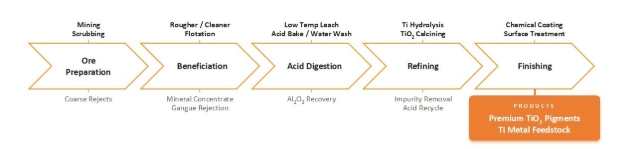
Figure 1. Integrated Processing Flowsheet Diagram – ore to premium products (the “Empire Process”)
The most recent product development testwork has been focused on converting the raw anatase product into a rutile crystal pigment product, which it has now successfully achieved by optimising the hydrolysis and calcination parameters during the Refining Stage. Using XRD analysis, all of the contained TiO2 was confirmed to be present as rutile crystal pigment. The chemical analysis of the sample however indicated a purity of only 97.6% TiO2 due mainly to the presence of 0.65% sulphur. Sulphur would normally be removed during the high temperature calcination process and so would not be expected to be a re-occurring issue. Correcting for this anomaly gives a calculated final pigment grade of 99.2% TiO2, with only a few minor elements slightly above the targeted specification.
Additional work is underway, building on the information gained from the earlier testwork programme, to optimise the impurity rejection in the final stages of the titanium hydrolysis and calcination process. This optimisation work will focus on establishing the conditions required to achieve rutile pigment with the required minimum levels of specific colour-forming deleterious elements to meet specification for architectural paints. A key processing advantage for Pitfield is the low amounts of deleterious elements in the orebody which means that the leach liquor feeding the refining stage is naturally low in these components, particularly when compared to that seen in the sulphate ilmenite industry.
The ability to convert the high-purity TiO2 (~99%) output from the Pitfield process flowsheet into a high-value rutile pigment is an important milestone for the Company. The next phase of product development will address both the optimisation of the Beneficiation to Refining stages and techniques for coating the rutile pigment (the “Finishing Stage”) so that the Company’s coated rutile pigment is suitable for use in the architectural paint market, where it is expected to attract a premium price.
The Company is now engaged in discussions with technical advisers that specialise in the field of titanium dioxide surface treatment to procure product development services, initial plant design and capital cost estimates for coating its raw pigment materials.
The flowsheet also offers the optionality to produce titanium metal feedstock given the purity of the raw, uncoated pigments being produced.
Market Strategy Update
Empire has been working closely with TiPMC Consulting (“TiPMC”), a USA based advisory group consisting of experienced titanium dioxide industry marketing and production experts, who have provided the following market insights:
- Current global titanium dioxide consumption, in the form of pigment, metal, and other applications, is estimated to exceed 8Mtpa with forecast compound annual growth of ~3.4% pa. The largest segment, being pigment grows at about 2.6% per annum. Approximately 91% of global titanium consumption is in the form titanium dioxide, with titanium metal accounting for a further 7%; and
- The titanium dioxide market is distributed roughly 93% to the rutile crystal form of TiO2 and 7% to the anatase crystal form of TiO2. Architectural coatings are the largest single sector and consume 2.3Mt annually, approximately 33% of the global TiO2 pigment produced.
Most architectural coatings use rutile crystal pigments that have undergone surface treatment, which involves coating the raw pigment particles to enhance gloss and paint coverage properties (“hiding power”). Production of coated rutile pigment instead of uncoated anatase significantly increases the value of the titanium dioxide pigment and addresses the largest market sector. Based on this Empire is developing a marketing strategy with its main initial focus on supplying the architectural coatings and paint market sector with coated rutile pigments.
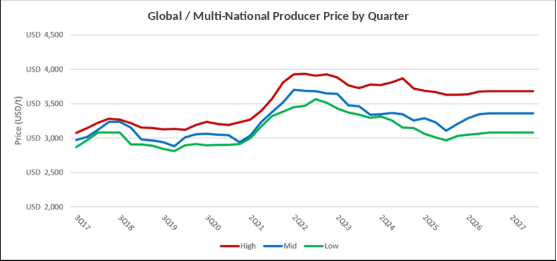
The mid-point for Tier 1 coated rutile pigment market prices are currently approximately US$3,250/t (see Figure 2, source: TiPMC).
Figure 2: Coated Rutile Pigment price, Global / Multi-National Producer weighted average
Notably, the next and final stage of pigment production is well-understood and not costly. By way of an external benchmark, independent cost data published by TiPMC in 2026 indicates production costs for the final finishing stage to convert raw pigments into coated rutile pigment suitable for architectural coatings in the range of approximately US$250 to US$320 per tonne for the sulphate route, with leading Chinese producers at the lower end. Notably final finishing costs for the chloride route are generally higher and can be up to US$520/tonne for European and North American producers.
Empire also sees a significant opportunity to supply raw uncoated pigment to the merchant market, which would be further refined and finished into high-value coated rutile pigments, particularly given the scarcity and high cost of existing, suitable high-grade feed sources.
Titanium Sponge Metal Development Pathway
The Company continues to develop a route to Ti metal production, either through its research into molten salt electrolysis at Murdoch University’s Extractive Metallurgy Hub in Western Australia, or via alternative titanium products, such as titanium tetrachloride (“TiCl4“), a precursor to making Ti metal sponge via the Kroll process.
The next phase of the molten salt electrolysis project at Murdoch University is underway, with the construction of a high temperature test rig now complete and being wet commissioned ahead of testing purchased TiO2 feedstock as proof of concept, before moving on to raw pigments produced from Pitfield ores. Completion of these phases remain on track for early 2027, with the objective of proving the suitability of Pitfield TiO₂ feedstock for titanium metal production and developing a strategy for scale-up to larger, continuous pilot operations.
As recently announced (16 September 2026) Empire’s research programme with Murdoch University has been accepted into the Critical Metals for Critical Industries CRC (“CMCI CRC”), established under the Australian Government’s Cooperative Research Centres Programme (“CRC Programme”). The CRC Programme is an Australian government-backed initiative supporting industry-led innovation and accelerating the commercialisation of globally competitive critical metals refining technologies.
Competent Person Statement
The scientific and technical information in this report that relates to process metallurgy is based on information reviewed by Ms Narelle Marriott, an employee of Empire Metals Australia Pty Ltd, a wholly owned subsidiary of Empire. Ms Marriott is a member of the AusIMM and has sufficient experience relevant to the style of mineralisation and type of deposit under consideration and to the activity being undertaken to qualify as a Competent Person as defined in the JORC Code 2012. Ms Marriott consents to the inclusion in this announcement of the matters based on their information in the form and context in which it appears.
Market Abuse Regulation (MAR) Disclosure
Certain information contained in this announcement would have been deemed inside information for the purposes of Article 7 of Regulation (EU) No 596/2014, as incorporated into UK law by the European Union (Withdrawal) Act 2018, until the release of this announcement.
**ENDS**
For further information please visit www.empiremetals.co.uk or contact:
| Empire Metals Ltd Shaun Bunn / Greg Kuenzel / Arabella Burwell |
Tel: 020 4583 1440 |
| S. P. Angel Corporate Finance LLP (Nomad & Joint Broker) Ewan Leggat / Adam Cowl |
Tel: 020 3470 0470 |
| Canaccord Genuity Limited (Joint Broker) James Asensio / Christian Calabrese / Rory Blundell / Charlie Hammond |
Tel: 020 7523 8000 |
| Zeus Capital Limited (Joint Broker) Harry Ansell / Katy Mitchell |
Tel: 020 3829 5000 |
| Tavistock (Financial PR) Emily Moss / Abigail Gilchrist / Eliza Logan |
empiremetals@tavistock.co.uk Tel: 020 7920 3150 |
| Chapter One Advisors (Australian Financial PR) David Tasker |
dtasker@chapteroneadvisors.com.au Tel: +61 433 112 936 |
About Empire Metals Limited
Empire Metals Ltd (AIM:EEE)(OTCQX:EPMLF) is an exploration and resource development company focused on the commercialisation of the Pitfield Titanium Project, located in Western Australia. The titanium discovery at Pitfield is of unprecedented scale and hosts the largest titanium resource reported globally (to JORC or equivalent standard), and among the highest grade, with a Mineral Resource Estimate (MRE) totalling 8.16 billion tonnes grading 4.3% TiO₂ for 349 million tonnes of contained TiO₂.
Titanium mineralisation at Pitfield occurs from surface and displays exceptional grade continuity along strike and down dip.
Conventional processing has already produced a high-purity product grading 99.25% TiO₂, targeting pigment and titanium sponge metal feedstock. With excellent logistics and established infrastructure, Pitfield is strategically positioned to supply the growing global demand for titanium and other critical minerals.
This information is provided by RNS, the news service of the London Stock Exchange. RNS is approved by the Financial Conduct Authority to act as a Primary Information Provider in the United Kingdom. Terms and conditions relating to the use and distribution of this information may apply. For further information, please contact rns@lseg.com or visit www.rns.com.
SOURCE: Empire Metals Limited
View the original press release on ACCESS Newswire
Media gallery